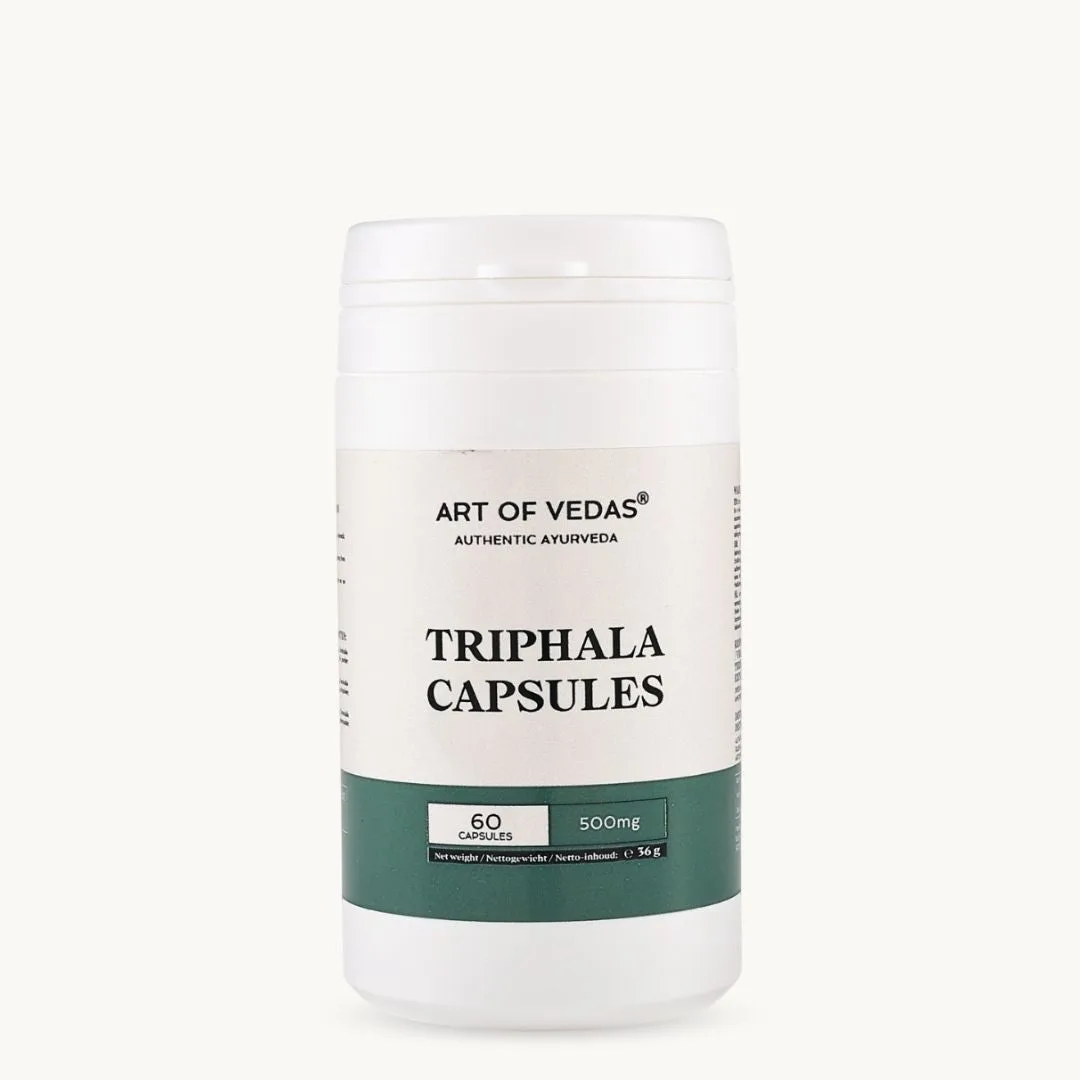
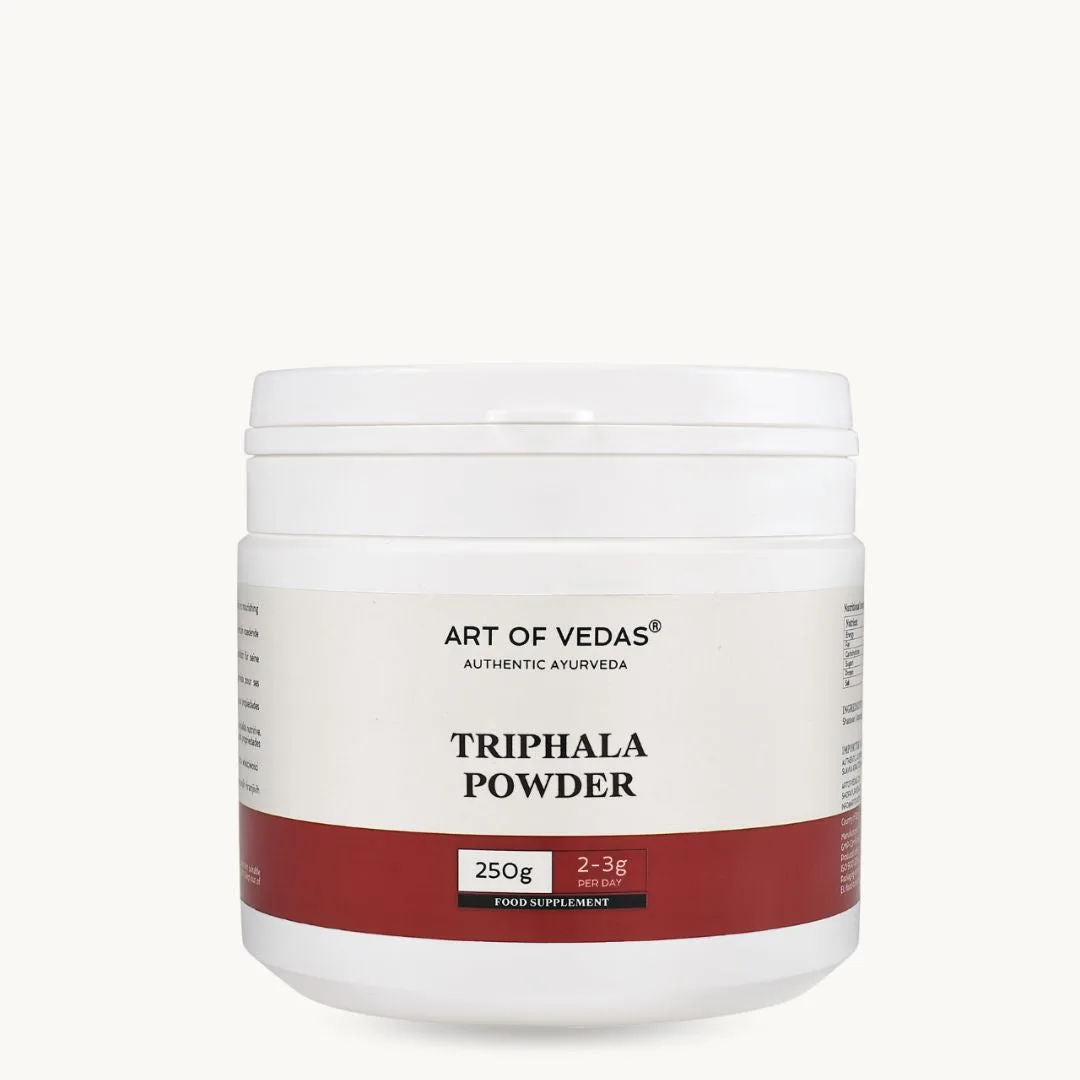
In brief: Questions about Triphala side effects have no single answer for everyone, and Art of Vedas makes no claims either way. What we can give you is what our labels say: keep to the recommended daily amount, do not take Triphala during pregnancy or while breastfeeding without advice, ask a doctor first if you take medication, and keep it out of the reach of children. A qualified Ayurvedic practitioner can tell you whether Triphala suits you.
Many people look up Triphala side effects, or ask whether Triphala is dangerous, before they start. These are fair questions. Triphala is a food supplement made from three dried fruits, Haritaki, Bibhitaki and Amalaki, and the classical texts describe it for regular use. Even so, no preparation suits every person in every situation. This page collects the precautions in one place. How much to take, and when, is explained in the guide Triphala dosage; how to take it with water, ghee or honey in how to take Triphala.
Is Triphala dangerous?
Art of Vedas does not describe Triphala as dangerous, and it does not describe it as free of any risk. Both would be claims. What can be said is this: Triphala is sold in the EU as a food supplement, its ingredients are declared on the label, and the label gives a daily amount and warnings. If you follow the label and take advice wherever a warning applies to you, what remains is a personal question that a doctor or a qualified Ayurvedic practitioner can answer for you.
What the labels say
- Do not exceed the recommended daily amount: ½ to 1 teaspoon (about 2 to 3 g) of Triphala Powder, 2 Triphala Capsules or 1 to 2 tablets of Triphala Vati a day.
- Food supplements should not be used as a substitute for a varied and balanced diet.
- Pregnancy and breastfeeding: the capsule label says not recommended; the powder and Vati labels ask you to consult a qualified practitioner first.
- Medication: consult a qualified practitioner or a doctor before use.
- Keep out of the reach of children.
- Triphala Ghritham and Maha Triphala Ghritham are taken under the guidance of a qualified Ayurvedic practitioner. Maha Triphala Ghritham contains liquorice and goat's milk.
Who should ask a practitioner first
Ask a doctor or a qualified Ayurvedic practitioner before you take Triphala if:
- you are pregnant, planning a pregnancy or breastfeeding
- Triphala is meant for a child
- you take medication of any kind
- you are under medical care or have a health condition
- you take other herbal preparations or food supplements at the same time
- you are unsure whether Triphala suits your constitution.
Bring the pack with you, so that the practitioner can see the form, the ingredients and the daily amount.
Why the tradition asks about the person first
The classical texts describe Triphala as suitable for all three Doshas and list it among the Rasayana. They also describe its Anulomana quality, a downward movement of Vata, and they adapt amount, time and Anupana to the person: Prakriti, age, season and the state of Agni. This is why the tradition gives no single rule for everyone, and why a practitioner asks about you before advising. The taste and the classical qualities of Triphala are explained in Triphala, its taste and the Doshas.
Different forms, different ingredients
Triphala Powder contains only the three fruits. Triphala Capsules contain the three fruits in a vegan capsule. Triphala Vati also contains ginger, long pepper, black pepper, Cyperus rotundus and Plumbago zeylanica. Triphala Ghritham is a ghee preparation made with milk and the three fruits. Read the ingredients of the form you choose before you start; the guide Churnam, Vati or capsule compares the forms.
When to stop and ask
If you notice anything after starting Triphala that you are unsure about, stop taking it and speak to a doctor or a qualified Ayurvedic practitioner. Do not increase the amount to make up for a missed day, and do not combine several Triphala products without advice.
Storage
Keep the pack closed, in a cool and dry place away from direct light, and out of the reach of children. Use a dry spoon for the powder so that no moisture gets into the pack. The Triphala Ghritham jars are batch-tested for heavy metals and microbiology.
Questions about Triphala side effects
Does Triphala have side effects? Art of Vedas makes no statement either way. Keep to the daily amount on the label, and ask a doctor or a qualified Ayurvedic practitioner if you are unsure, take medication, are pregnant or are breastfeeding.
Is Triphala dangerous? We describe it neither as dangerous nor as free of risk. It is a food supplement with a daily amount and warnings on the label; whether it suits you is a personal question for a practitioner.
Can I take Triphala during pregnancy? Not without advice. The capsule label says it is not recommended during pregnancy or breastfeeding, and the powder label asks you to consult a qualified practitioner first.
Can Triphala be taken with medication? Ask your doctor before you start, and bring the pack so that the ingredients can be checked.
Is Triphala suitable for children? Only after asking a paediatrician or a qualified Ayurvedic practitioner. Keep it out of the reach of children.
Can I take Triphala every day? The classical texts describe it as a Rasayana for regular use. Keep to the daily amount and agree longer use with a practitioner; the guide Triphala dosage explains amount, timing and duration.
Related Triphala guides
This page does not replace medical advice. Food supplements should not be used as a substitute for a varied and balanced diet.